
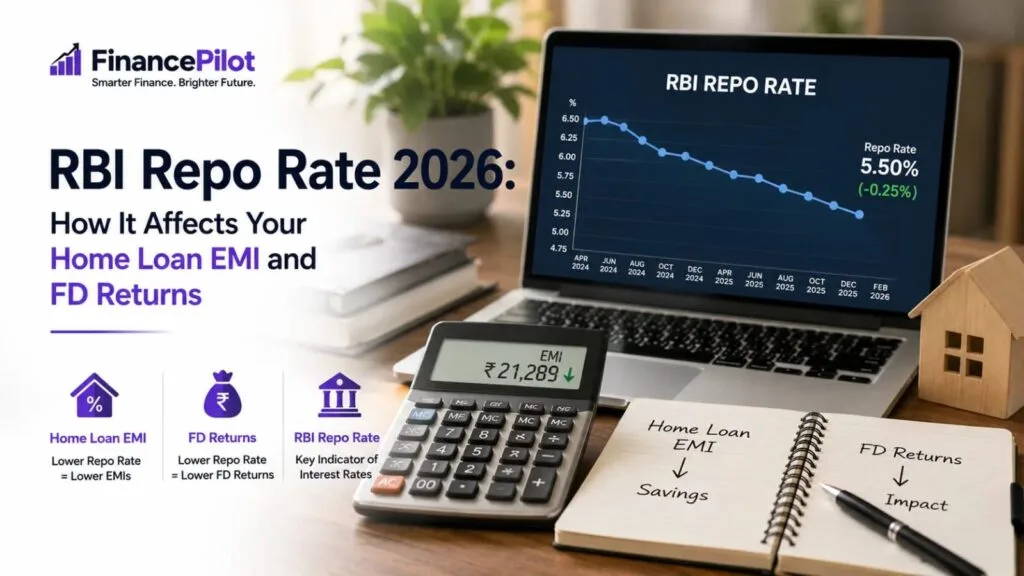
The Reserve Bank of India’s Monetary Policy Committee kept the repo rate unchanged at 5.25 percent at its August 2026 meeting, held from August 3 to August 5. This marks the fourth consecutive review where the RBI has chosen to pause, following its last actual rate cut back in December 2025, when the rate was lowered from 5.5 percent to its current level. The committee retained a neutral stance and unanimously voted 6-0 to hold rates steady
If you have a home loan or a fixed deposit, this pause matters more than it might seem at first glance. Here is exactly what the repo rate means, how it flows through to your EMI or your FD returns, and what the current wait-and-watch stance suggests for your next move.
What Is the Repo Rate, in Plain Terms
The repo rate is the interest rate at which the RBI lends short-term funds to commercial banks, typically against government securities as collateral. When the RBI raises this rate, borrowing becomes more expensive for banks, and they typically pass that cost on to customers through higher loan rates. When the RBI cuts the rate, banks’ own borrowing costs fall, and lending rates tend to ease as a result, provided banks choose to pass on the benefit.
Where the Repo Rate Stands in 2026
| MPC Meeting | Repo Rate | Change |
|---|---|---|
| February 2025 | 6.25% | Cut from 6.50% |
| April to October 2025 | Progressive cuts | Down to 5.50% |
| December 2025 | 5.25% | Cut from 5.50% |
| February 2026 | 5.25% | Held |
| April 2026 | 5.25% | Held |
| June 2026 | 5.25% | Held |
| August 2026 | 5.25% | Held (4th consecutive pause) |
Alongside the repo rate, the Standing Deposit Facility rate currently stands at 5.00 percent, while the Marginal Standing Facility rate and Bank Rate are both at 5.50 percent. RBI Governor Sanjay Malhotra described the current approach as “neither dovish nor hawkish,” with future decisions dependent on how inflation and growth data evolve. The next MPC meeting is scheduled for October 5 to 7, 2026.
How the Repo Rate Affects Your Home Loan EMI
Most floating-rate home loans taken after October 2019 are linked to an External Benchmark Lending Rate, most commonly the repo rate itself, under what is called a Repo Linked Lending Rate, or RLLR, structure. This means changes in the repo rate transmit to your loan interest rate far faster than they did under the older MCLR-linked system, often within a quarter, since regulations require banks to reset repo-linked loan rates at least once every three months.
Since the repo rate has been held steady through four consecutive meetings, borrowers on RLLR-linked loans should not expect any near-term change to their EMI purely from RBI policy. Your EMI would only move if your bank adjusts its own spread over the repo rate, which is less common outside of a formal rate change.
What a Rate Change Would Look Like on Your EMI
To put this in concrete terms, consider a ₹50 lakh home loan over a 20-year tenure. At an effective lending rate of around 8.5 percent, the EMI works out to approximately ₹43,391 per month. A 0.25 percent rate cut, bringing the effective rate to 8.25 percent, would lower the EMI to roughly ₹42,603, a saving of about ₹788 per month, or close to ₹1.9 lakh over the full loan tenure. Small repo rate movements compound meaningfully over a long tenure, which is exactly why the RBI’s pause-versus-cut decision each policy cycle matters to existing borrowers.
If you are evaluating whether to buy property while rates remain steady, our real estate investment guide covers how financing costs factor into your overall investment decision, and our personal loan guide is useful if you are comparing loan types beyond housing finance.
How the Repo Rate Affects Your FD Returns
Fixed deposit rates typically move in the same direction as the repo rate, though banks usually adjust FD rates with a lag and based on their own liquidity needs rather than mechanically tracking RBI moves. When the repo rate was cut through 2025, most banks gradually trimmed their FD rates in response, since their own cost of funds had eased.
With the repo rate steady since December 2025, FD rates across most banks have also largely stabilised, though the exact rate still varies by bank, tenure and depositor category, with senior citizens typically getting a premium of 0.25 to 0.50 percent over standard rates. Since rates have plateaued rather than continuing to fall, this pause has actually worked in favour of FD investors compared to a scenario of continued rate cuts, since your returns are not eroding further for now.
Should You Lock In Your FD Rate Now
With the RBI’s neutral stance and a data-dependent approach heading into the October meeting, there is a reasonable case for locking in current FD rates on a longer tenure if you are risk-averse and want returns to be less exposed to a future rate cut. If the MPC does eventually resume cutting rates later in the cycle, FD rates offered on new deposits would likely soften, making current levels comparatively attractive for anyone who has been waiting on the sidelines. If you want to compare fixed income options beyond bank FDs, our guide to bonds covers alternatives that may offer a different risk-return trade-off for the same holding period.
What This Pause Signals for Borrowers and Savers
The RBI’s own commentary points to a genuinely balanced set of considerations behind the pause. On one hand, the MPC raised its FY27 GDP growth forecast to 6.7 percent, up from 6.6 percent at the June meeting, reflecting confidence in domestic economic resilience. On the other, the central bank flagged renewed geopolitical tension in West Asia since early July 2026 as a risk that extends beyond crude oil prices to fertiliser availability, shipping routes and broader financial market volatility, alongside an uneven monsoon and global trade policy uncertainty.
This combination, resilient domestic growth alongside genuine external risks, is why the MPC has chosen to hold rather than move in either direction. For both borrowers and depositors, the practical takeaway is the same: the current rate environment is likely to persist at least through the October review, barring a meaningful shift in the inflation or growth data the RBI is watching.
Frequently Asked Questions
What is the current RBI repo rate in 2026?
As of the August 2026 MPC meeting, held from August 3 to August 5, the repo rate stands at 5.25 percent, unchanged for the fourth consecutive policy review since the last cut in December 2025.
How quickly does a repo rate change affect my home loan EMI?
If your loan is linked to the Repo Linked Lending Rate, changes typically transmit within a quarter, since banks are required to reset repo-linked rates at least once every three months. Older MCLR-linked loans generally see slower transmission.
Will FD rates fall since the RBI has kept rates unchanged?
Since the repo rate has been held steady since December 2025, most banks have also stabilised their FD rates rather than continuing to cut them. Rates would likely only move again if the RBI resumes rate cuts in a future policy review.
When is the next RBI MPC meeting in 2026?
The next Monetary Policy Committee meeting is scheduled for October 5 to 7, 2026, where the RBI will reassess its stance based on updated inflation and growth data.
Should I choose a fixed or floating rate home loan right now?
With the repo rate steady and the RBI maintaining a neutral, data-dependent stance, floating rate loans linked to the repo rate offer more flexibility to benefit if rates eventually fall, while a fixed rate offers certainty if you prioritise predictable EMIs over potential future savings. The right choice depends on your risk tolerance and loan tenure.