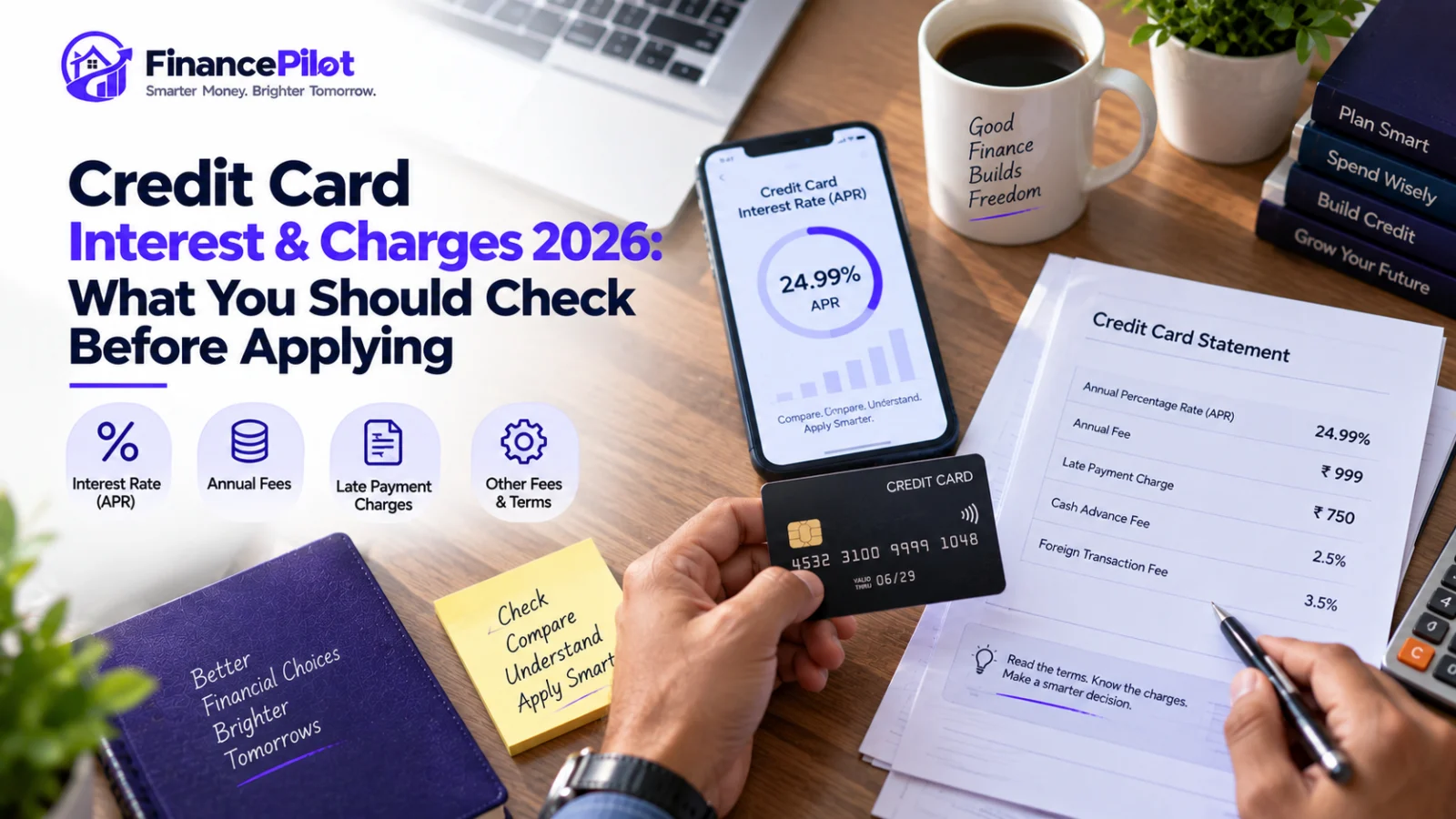
A credit card’s advertised interest rate is only one line item on a page full of them, and the ones that quietly cost the most are rarely the ones featured in the marketing. Forex markup, overlimit fees, cash advance charges, and a redemption fee just to use your own reward points, none of these show up in the glossy comparison you see before applying, but all of them are legally required to be disclosed somewhere specific: a document called the Most Important Terms and Conditions, or MITC.
Here is the full checklist of charges worth reviewing before you apply for any credit card, with real figures and the one document that legally has to contain all of them.
Start With the MITC, Not the Marketing Page
Under RBI’s Master Direction on Credit Card and Debit Card Issuance and Conduct, every card issuer is legally required to publish a Most Important Terms and Conditions document, presented in bold text of at least 12-point font, and this must be given to you before your card is even activated. Every fee discussed below is required to appear in this document. If a charge later shows up on your statement that is not disclosed in your MITC, you have a genuine basis to dispute it under RBI’s Charter of Customer Rights, rather than simply accepting it as an unavoidable cost of card ownership.
Interest Rate: Look Past the “Attractive” Headline Number
Credit card interest in India typically ranges from 1.5 to 3.6 percent per month, working out to 18 to 43 percent annually, applied whenever you carry a balance beyond your due date. This rate only becomes relevant if you do not pay your full statement balance, and comparing this figure across cards is worth doing even if you plan to always pay in full, since plans occasionally slip. Our guide to RBI’s 3-day late payment grace period covers a related distinction worth understanding before you apply, since a late fee waiver and interest avoidance are not the same protection.
Joining and Annual Fee: Check the Waiver Threshold Carefully
Annual fees range from genuinely free, on select lifetime-free cards, up to ₹10,000 or more on premium travel cards, sometimes reaching ₹40,000 for super-premium metal cards. Many mid-tier cards waive this fee once you cross an annual spending threshold, but this threshold varies meaningfully by card and is easy to miss if your actual spending pattern does not naturally align with it. Before applying, check your realistic annual spend against this specific waiver condition rather than assuming a “fee waived on spends” card will automatically end up free for you.
Foreign Transaction Markup: A Real Cost With a Real Example
If you travel internationally or shop on foreign websites, this fee matters considerably more than most cardholders realise. Forex markup on Indian credit cards ranges from 0 percent on select cards to as much as 3.5 percent on standard entry-level cards, with GST charged on top of the markup itself. Consider a $30 purchase at an exchange rate of ₹89, coming to ₹2,670. A 2 percent markup adds ₹53.40, and 18 percent GST on that markup fee adds a further ₹9.61, bringing your actual cost to roughly ₹2,733, about 2.4 percent more than the base transaction value. Across a full international trip, this difference compounds quickly, which is exactly why frequent travellers are generally better served choosing a card by its forex markup rather than by its lounge access benefits.
Cash Advance Fee: The Charge With No Grace Period
Withdrawing cash using your credit card triggers a cash advance fee, typically 2.5 to 3 percent of the withdrawn amount, and interest on this withdrawal begins accruing from day one, with no interest-free grace period the way a regular purchase enjoys. This combination makes a credit card cash withdrawal one of the most expensive ways to access money available to a cardholder, and it is worth checking this specific fee even if you have no current intention of ever using it.
Overlimit Fee: An Opt-In Charge You Can Disable
If you spend beyond your approved credit limit on a card that permits overlimit transactions, you are typically charged around 2.5 to 3 percent of the overlimit amount, subject to a minimum, commonly ₹500 to ₹600. This fee only applies if you have specifically opted into overlimit usage, and calling your card issuer to disable this feature entirely removes the risk of ever incurring it.
Fuel Surcharge and the Fine Print on Its Waiver
Most fuel purchases attract a 1 percent surcharge, though the majority of cards waive this within a specific transaction range, commonly ₹400 to ₹5,000. The detail worth checking before you apply is the maximum waiver cap per billing cycle, often capped around ₹250 to ₹500 regardless of how many qualifying fuel transactions you make, a limit that matters if you drive frequently and expect the waiver to apply without a ceiling.
EMI Conversion and the “No-Cost EMI” Catch
Converting a purchase to EMI typically carries a processing fee in the range of ₹99 to ₹250, and it is worth being specific about what “no-cost EMI” actually means. It generally refers to zero additional interest, not zero cost altogether, since the processing fee still applies, and in many cases the base price of the item itself is adjusted upward to fund the interest discount before the EMI conversion is even offered.
Cheque and Auto-Debit Bounce Fees
If an auto-debit payment for your credit card bill fails due to insufficient funds, you can be charged a bounce fee in the range of ₹500 to ₹600 plus GST, and your bank account itself may separately levy an additional ECS bounce charge of ₹200 to ₹500 for the same failed transaction. This makes maintaining sufficient balance ahead of your auto-debit date worth double-checking, since the cost of a bounced payment compounds across both your card and your bank account simultaneously.
Reward Redemption Fee: Paying to Use Your Own Points
Several cards charge a fee, commonly ₹99 to ₹100, simply to process a reward point redemption request. This is worth checking specifically if a card’s rewards program is a major factor in your decision, since a redemption fee quietly erodes the value of points you have already earned through your spending.
Foreclosure or Card Closure Fee
If you choose to close or cancel a card with an outstanding balance, RBI regulations cap this foreclosure charge at 3 percent of the outstanding amount. Our guide to how a credit card actually works covers the billing cycle mechanics that determine your outstanding balance at any given point, which directly affects what this closure fee would actually cost you if you decided to exit a card mid-cycle.
The 18 Percent GST That Applies to Every Single Fee
This is worth internalising as a blanket rule rather than checking fee by fee. Every charge discussed above, joining fee, annual fee, interest, late fee, forex markup, and every other listed cost, attracts an additional 18 percent GST under CGST and SGST rules. A quoted “₹5,000 annual fee” is genuinely a ₹5,900 charge once GST is added, and mentally applying this uplift to every advertised figure gives you a more accurate comparison across cards than taking headline numbers at face value.
What to Do If a Charge Is Not in Your MITC
If a fee appears on your statement that you cannot locate anywhere in your card’s MITC document, this is a legitimate basis for a formal dispute, not merely an awkward customer service conversation. Request your MITC document directly from your issuer if you were not given one at activation, since RBI mandates this disclosure specifically to prevent exactly this kind of surprise charge. Our guide to minimum due versus total due is worth reading alongside this checklist, since a disputed fee sometimes surfaces on the same statement as a minimum due calculation question, and both are worth reviewing together before you escalate a complaint.
Frequently Asked Questions
What is the MITC document and why does it matter?
The Most Important Terms and Conditions, or MITC, is a document every credit card issuer is legally required to provide before your card is activated, presented in bold, at least 12-point font, listing every applicable fee and charge. If a charge later appears that is not disclosed in this document, you have a genuine basis to dispute it under RBI’s Charter of Customer Rights.
How much does forex markup actually add to an international purchase?
Forex markup ranges from 0 to 3.5 percent depending on the card, with 18 percent GST charged on top of the markup fee itself. On a typical international purchase, this combination can add roughly 2 to 4 percent to your actual cost compared to the base transaction value.
Is “no-cost EMI” genuinely free?
Not entirely. No-cost EMI typically means zero additional interest is charged, but a processing fee, commonly ₹99 to ₹250, still applies, and the base price of the product is sometimes adjusted upward before the EMI conversion is offered.
Can I avoid the overlimit fee entirely?
Yes. The overlimit fee only applies if you have opted into overlimit transaction usage on your card. Calling your issuer to disable this feature removes the possibility of ever being charged this fee, regardless of how much you spend.
Does GST apply to every credit card fee?
Yes. An 18 percent GST applies to every fee and charge on a credit card, including the joining fee, annual fee, interest, late fee, and forex markup, meaning the actual cost of any advertised fee is consistently higher than the headline figure by this percentage.