There was a time when getting a personal loan meant standing in a bank queue with a folder full of photocopies. That process has changed. Today, most lenders and loan apps in India can approve and disburse a personal loan using little more than your PAN card and a handful of basic KYC documents, often within a few hours.
This guide explains how PAN-based personal loans work, what documents you actually need, how the digital verification process happens, and what to check before you apply so you do not end up dealing with an unregistered lender.
What Is a Personal Loan on PAN Card
A personal loan on PAN card is an unsecured loan where your PAN acts as the primary identity and financial reference point during application. It does not mean the PAN card alone gets you the loan. Instead, it means the PAN is the anchor document that lenders use to pull your credit history, verify your identity, and cross-check other KYC details digitally, cutting down the paperwork you would normally submit in person.
Since these loans are unsecured, no property, gold or other asset needs to be pledged. Approval is based purely on your income, credit profile and repayment history.
Why the PAN Card Matters So Much
It Links to Your Financial Identity
Your PAN is connected to your income tax records, past loans, credit card usage and repayment behaviour. When a lender pulls your PAN details, they get a fairly complete picture of your creditworthiness in seconds, which is why it has become the backbone of fast, digital lending in India.
It Speeds Up Credit Checks
Instead of manually verifying paper documents, lenders use your PAN to instantly fetch your credit report from bureaus like CIBIL, Experian or Equifax. This is one of the main reasons approval that once took days can now happen within minutes on many digital lending apps.
KYC Documents You Will Actually Need
While the PAN card is central, it is not the only document required. Reserve Bank of India KYC norms require at least one more valid ID and address proof alongside your PAN.
Mandatory Documents
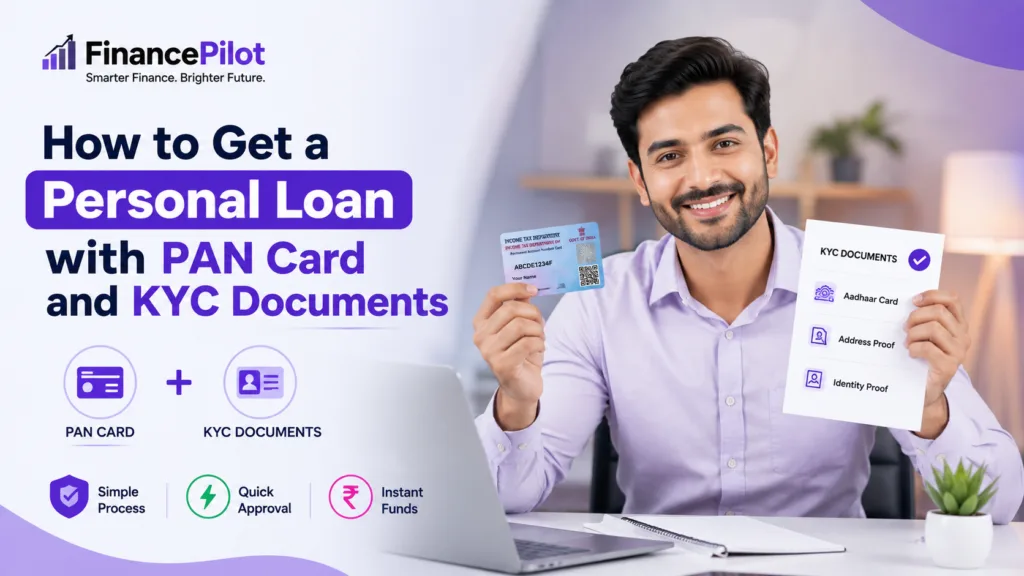
- PAN Card, used for identity and credit history verification
- Aadhaar Card, used for identity and address verification through eKYC
- A recent photograph, usually captured live during the app based verification process
Additional Documents Some Lenders May Ask For
- Voter ID, passport or driving licence, as an alternate or additional ID proof
- Bank statements for the last three to six months, to verify income and spending patterns
- Salary slips, for salaried applicants, or ITR copies for self-employed applicants
- Utility bills, if address proof needs separate verification from Aadhaar
Keeping digital copies of these ready in advance can shave a significant amount of time off your application.
Step by Step Process to Apply
Choose a Registered Lender
Before anything else, confirm that the lender or app you are using is registered with the RBI or partnered with an RBI-regulated bank or NBFC. You can verify this on the RBI’s Sachet portal. This single step protects you from a large number of fraudulent lending apps that have flooded app stores in recent years.
Complete the Online Application
Most platforms ask for your mobile number first, verified through an OTP, followed by basic personal and employment details. You then enter your PAN number, which the system uses to run an instant credit check in the background.
Complete eKYC Verification
This is usually the fastest part of the process. You upload your Aadhaar details, complete OTP verification linked to your Aadhaar registered mobile number, and in many cases take a live selfie that gets matched against your Aadhaar photo. The entire eKYC step often completes within two to three minutes.
Bank Account Verification
Lenders confirm your bank account through a penny drop, a small test transaction, or by linking your account through net banking. This ensures the loan amount lands in a verified, active account.
Approval and Disbursal
Once your documents, credit score and income details are verified, approval decisions are often generated within minutes for smaller loan amounts. Disbursal to your bank account typically happens within a few hours to 24 hours, depending on the lender.
How Much Loan Amount Can You Get
Loan amounts on PAN based personal loans vary widely depending on the lender and your profile. Smaller digital lending apps often start with loans in the range of ₹10,000 to ₹50,000 for first-time borrowers with limited credit history. As your credit profile strengthens and you build a repayment track record, established banks and larger NBFCs can extend PAN-linked personal loans of ₹1 lakh up to ₹5 lakh or more, based on income, credit score and existing obligations.
A CIBIL score of around 685 or higher generally improves your chances of both approval and a better loan amount, while scores closer to 650 may still get approved but with a smaller sanctioned limit.
Safety Checks Before You Apply
The convenience of PAN and Aadhaar based lending has unfortunately also attracted a number of fraudulent apps that misuse personal data or charge hidden fees. Before sharing your documents with any platform, keep these checks in mind.
- Confirm the lender’s registration status on the RBI Sachet portal
- Avoid apps that ask for upfront processing fees before disbursal
- Read the loan agreement carefully for interest rate, tenure and prepayment charges
- Check app permissions, since a legitimate lending app should not need access to your entire contact list or photo gallery
- Prefer lenders that clearly display their NBFC or bank partnership details on their website or app
Tips to Get Approved Faster
- Keep your Aadhaar mobile number active and updated, since most eKYC steps depend on it
- Check your credit score before applying so you know roughly where you stand
- Apply with a lender whose eligibility criteria genuinely match your income and credit profile, rather than applying broadly across multiple apps
- Ensure your bank account details and PAN details match exactly across all documents, since mismatches are a common reason for delays
Frequently Asked Questions
Can I get a personal loan using only my PAN card?
Not entirely on its own. Your PAN card is the primary reference for identity and credit checks, but RBI KYC norms require at least one additional valid ID, most commonly Aadhaar, along with address verification.
How long does PAN and Aadhaar based eKYC take?
The eKYC step itself usually completes within two to three minutes, since it relies on OTP verification and digital matching rather than physical document checks.
Is a personal loan with just PAN and KYC documents safe?
It can be, as long as you apply through an RBI-registered bank or NBFC. You can verify a lender’s registration on the RBI Sachet portal before sharing any personal or financial documents.
What loan amount can I expect with basic KYC documents?
First-time borrowers with limited credit history are often offered smaller amounts, typically ₹10,000 to ₹50,000. Established banks and larger NBFCs can extend up to ₹5 lakh or more for applicants with a strong credit score and income proof.
Do self-employed applicants need different documents for a PAN based loan?
Yes, in most cases. Alongside PAN and Aadhaar, self-employed applicants are usually asked for Income Tax Returns and bank statements instead of salary slips, since there is no fixed monthly salary to verify.