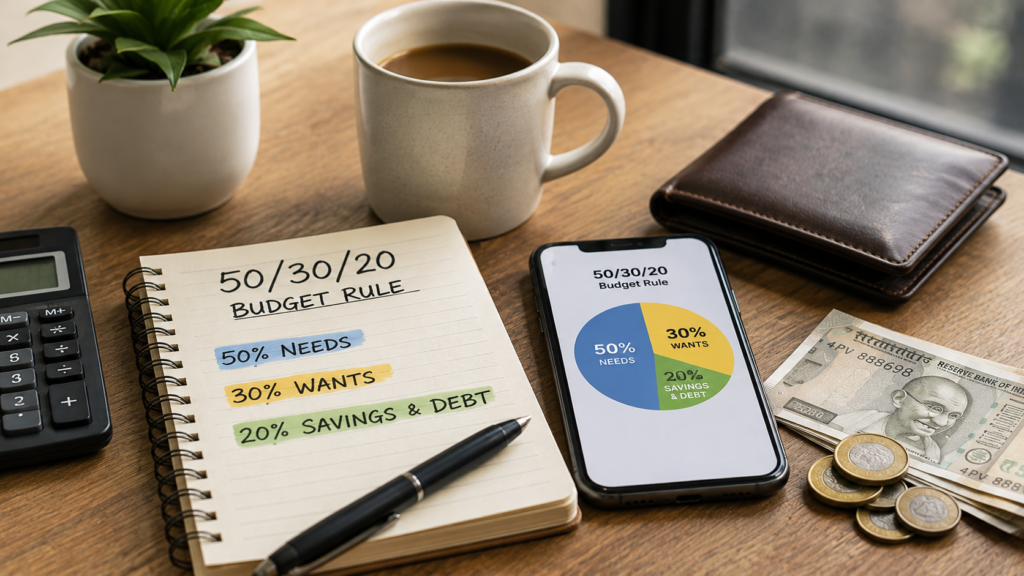

A personal budget is a plan that tracks your income against your expenses so you know exactly where your money goes each month. To build one in India, list your monthly income, categorize your expenses (needs, wants, savings), pick a budgeting method such as the 50-30-20 rule, and review it every month. A working budget helps you avoid debt, build an emergency fund, and save consistently toward goals like a home down payment or retirement.
Introduction
Most people don’t struggle with earning money — they struggle with knowing where it went. A personal budget solves that problem by giving every rupee a job before the month begins.
In this guide, you’ll learn what a personal budget actually is, how to build one from scratch using Indian income and expense patterns, which budgeting method suits different life stages, and the common mistakes that cause budgets to fail within a few weeks. Whether you’re a salaried professional in your first job, a freelancer with irregular income, or someone managing a household budget for the first time, the steps below apply to you.
What Is a Personal Budget?
A personal budget is a written or digital plan that compares your income to your expenses over a fixed period, usually a month. It shows how much money is coming in, where it’s going out, and how much is left over for savings or debt repayment.
A budget isn’t a restriction — it’s a decision-making tool. Instead of wondering at the end of the month why your bank balance is lower than expected, a budget tells you in advance what you can spend, save, and invest.
How Does Budgeting Work?
Budgeting works on a simple principle: Income − Expenses = Savings (or Shortfall). Here’s how the process typically flows:
- Calculate your total monthly income — salary, freelance income, rental income, or any other regular inflow.
- List all expenses — fixed costs like rent and EMIs, variable costs like groceries and fuel, and occasional costs like annual insurance premiums.
- Assign every rupee a category — needs, wants, savings, and debt repayment.
- Compare planned spending to actual spending — track transactions through the month using a notebook, spreadsheet, or budgeting app.
- Adjust and repeat — refine categories each month based on what actually happened.
The goal is not perfection in month one. It’s building a realistic picture of your cash flow that becomes more accurate over time.
Why Does Budgeting Matter?
A budget has a direct impact on your financial stability. Without one, it’s easy to spend based on what’s left in your bank account rather than what you can actually afford, which often leads to credit card debt or an inability to handle unexpected expenses.
With a budget, you can:
- Build an emergency fund before a crisis forces you into debt
- Pay EMIs and credit card bills on time, protecting your credit score
- Save systematically for goals like a wedding, a home down payment, or retirement
- Reduce financial stress by knowing your numbers instead of guessing
For Indian households in particular, where a large share of expenses can be irregular (festivals, family obligations, school admission fees), a budget helps smooth out these lumpy costs across the year instead of being caught off guard.
Step-by-Step: Building Your Personal Budget in India
Step 1: Calculate Your Real Monthly Income
Use your take-home salary (after tax deductions and PF contributions), not your CTC. If you have variable income — freelance work, commissions, or a side business — use the average of your last 3–6 months as a conservative base.
Step 2: List and Categorize Your Expenses
Break expenses into three broad buckets:
- Fixed/Needs: Rent or home loan EMI, utilities, groceries, insurance premiums, school fees, transport
- Discretionary/Wants: Dining out, OTT subscriptions, shopping, travel, entertainment
- Savings & Debt Repayment: SIP investments, PPF/EPF contributions, emergency fund, credit card or loan repayment beyond the minimum
Step 3: Choose a Budgeting Method
Pick a framework that matches your income stability and goals. See the comparison below.
Step 4: Track Spending Through the Month
Use a simple expense tracker — a spreadsheet, a notebook, or a budgeting app that links to your bank account or UPI transactions. Consistency matters more than the tool you choose.
Step 5: Review and Adjust Monthly
At the end of each month, compare planned versus actual spending. Categories will rarely match exactly in the first few months — that’s normal. Adjust the numbers rather than abandoning the process.
Choosing a Budgeting Method
| Method | How It Works | Best Suited For |
|---|---|---|
| 50-30-20 Rule | 50% needs, 30% wants, 20% savings/debt repayment | People with stable salaried income wanting a simple starting framework |
| Zero-Based Budgeting | Every rupee of income is assigned a category until the balance reaches zero | People who want granular control or are working to pay off debt |
| Envelope System | Cash or virtual “envelopes” are set for each spending category; once empty, spending in that category stops | People who overspend on discretionary categories and need a hard limit |
| Pay-Yourself-First | A fixed savings/investment amount is deducted right after income arrives, before any spending | People who struggle to save consistently and want savings automated |
None of these methods is universally “best” — the right one depends on your income pattern, financial discipline, and goals. Many people combine elements of more than one, for example using pay-yourself-first for savings automation alongside a 50-30-20 split for the rest.
Example: A Simple Monthly Budget
Assumptions: This example uses a hypothetical take-home salary of ₹60,000/month for a single salaried individual in a metro city. Actual numbers will vary significantly based on city, family size, and lifestyle — this is illustrative only, not a benchmark to match.
| Category | Allocation (50-30-20 Rule) | Amount (₹) |
|---|---|---|
| Needs (rent, groceries, utilities, transport) | 50% | 30,000 |
| Wants (dining, entertainment, shopping) | 30% | 18,000 |
| Savings & Investments (SIP, emergency fund, PF) | 20% | 12,000 |
| Total | 100% | 60,000 |
If fixed needs in a particular city genuinely exceed 50% of income — common in high-rent metros — the ratio can be adjusted (for example 60-20-20), as long as some portion is still consistently directed toward savings.
Benefits of Personal Budgeting
- Clear visibility into spending patterns and financial habits
- Reduced reliance on credit cards or loans for routine expenses
- Faster progress toward specific goals like an emergency fund or down payment
- Early warning signs when spending is trending in an unsustainable direction
- Greater confidence during salary negotiations, career changes, or unexpected income gaps
Risks, Limitations and Things to Consider
- Irregular income makes fixed percentages harder to apply. Freelancers and gig workers may need to budget off a conservative average income rather than the best month.
- A budget is only as accurate as the tracking behind it. Skipping expense tracking for a few weeks can make the numbers unreliable.
- Over-restriction can backfire. Budgets that leave no room for discretionary spending are harder to sustain and more likely to be abandoned entirely.
- A budget doesn’t replace insurance or an emergency fund. It helps you save toward them, but a single large unplanned expense (medical emergency, job loss) can still disrupt any budget without adequate buffers in place.
- Inflation and lifestyle changes require periodic revisions. A budget built two years ago may no longer reflect current rent, grocery, or fuel costs.
Common Mistakes to Avoid
- Setting an unrealistically strict budget that gets abandoned within a month
- Forgetting irregular expenses like annual insurance premiums, festival spending, or vehicle servicing
- Not building an emergency fund before aggressively investing
- Using gross salary instead of take-home salary for calculations
- Tracking expenses inconsistently, which makes month-to-month comparisons meaningless
- Treating a budget as a one-time exercise instead of a monthly habit
How to Get Started
- Pull up your last three months of bank and UPI statements to understand your actual spending pattern
- Calculate your average take-home income
- Sort your last three months of expenses into needs, wants, and savings
- Pick a budgeting method (start simple — 50-30-20 is a reasonable default for most salaried individuals)
- Set up a tracking system, whether a spreadsheet or an app
- Automate savings transfers right after salary credit, if possible
- Review the budget at the end of the first month and adjust categories based on what you learned
Frequently Asked Questions
1. How much of my salary should I save every month? A commonly referenced starting point is around 20% of take-home income, as suggested by the 50-30-20 rule. That said, the right savings rate depends on your expenses, debt obligations, and goals, and can be adjusted based on individual financial circumstances.
2. What is the best budgeting method for beginners in India? The 50-30-20 rule is generally the easiest starting point because it uses broad categories rather than requiring detailed tracking of every expense. Beginners can move to more granular methods like zero-based budgeting once they have a clearer sense of their spending patterns.
3. How do I budget with an irregular or freelance income? Base your budget on the average of your lowest-earning months over the past 6–12 months rather than your best month. This conservative baseline reduces the risk of overspending during leaner months.
4. Should I pay off debt or build an emergency fund first? Financial guidance commonly suggests building at least a small starter emergency fund (covering one month of essential expenses) before aggressively paying off debt, since this buffer prevents new debt from unexpected expenses. After that, high-interest debt (such as credit card debt) is often prioritized for repayment given the compounding cost of interest, while continuing minimum payments on other obligations. Individual circumstances vary, so this is worth weighing against your specific interest rates and financial situation.
5. How many months of expenses should my emergency fund cover? Emergency fund recommendations often range from 3 to 6 months of essential expenses, with some suggesting more for people with irregular income or dependents. The right number depends on job stability, number of dependents, and existing insurance coverage.
6. What’s the difference between a budget and a financial plan? A budget manages day-to-day and month-to-month cash flow — income versus expenses. A financial plan is broader and includes long-term goals such as retirement planning, insurance coverage, tax planning, and investment strategy. A budget is typically one component of a larger financial plan.
7. Which budgeting apps are commonly used in India? Several apps allow expense tracking through UPI and bank-linked transactions, though specific app recommendations and their features change frequently. It’s worth comparing data privacy practices, bank-linking security, and subscription costs before choosing one, rather than relying on any single recommendation.
8. How often should I revisit my budget? A monthly review is generally sufficient for most people, with a more thorough review every 6–12 months or after a major life change (new job, marriage, relocation) to reassess category allocations.
Conclusion
Creating a personal budget in India doesn’t require complex tools or financial expertise — it requires an honest look at your income and expenses, a method that fits your life, and the consistency to review it every month. Start with the 50-30-20 rule if you’re unsure where to begin, track your spending for a full month before making adjustments, and treat the budget as a living document rather than a fixed rulebook. As a practical next step, pull up your last month’s bank statement today and sort those transactions into needs, wants, and savings — that single exercise will tell you more about your finances than any calculator.