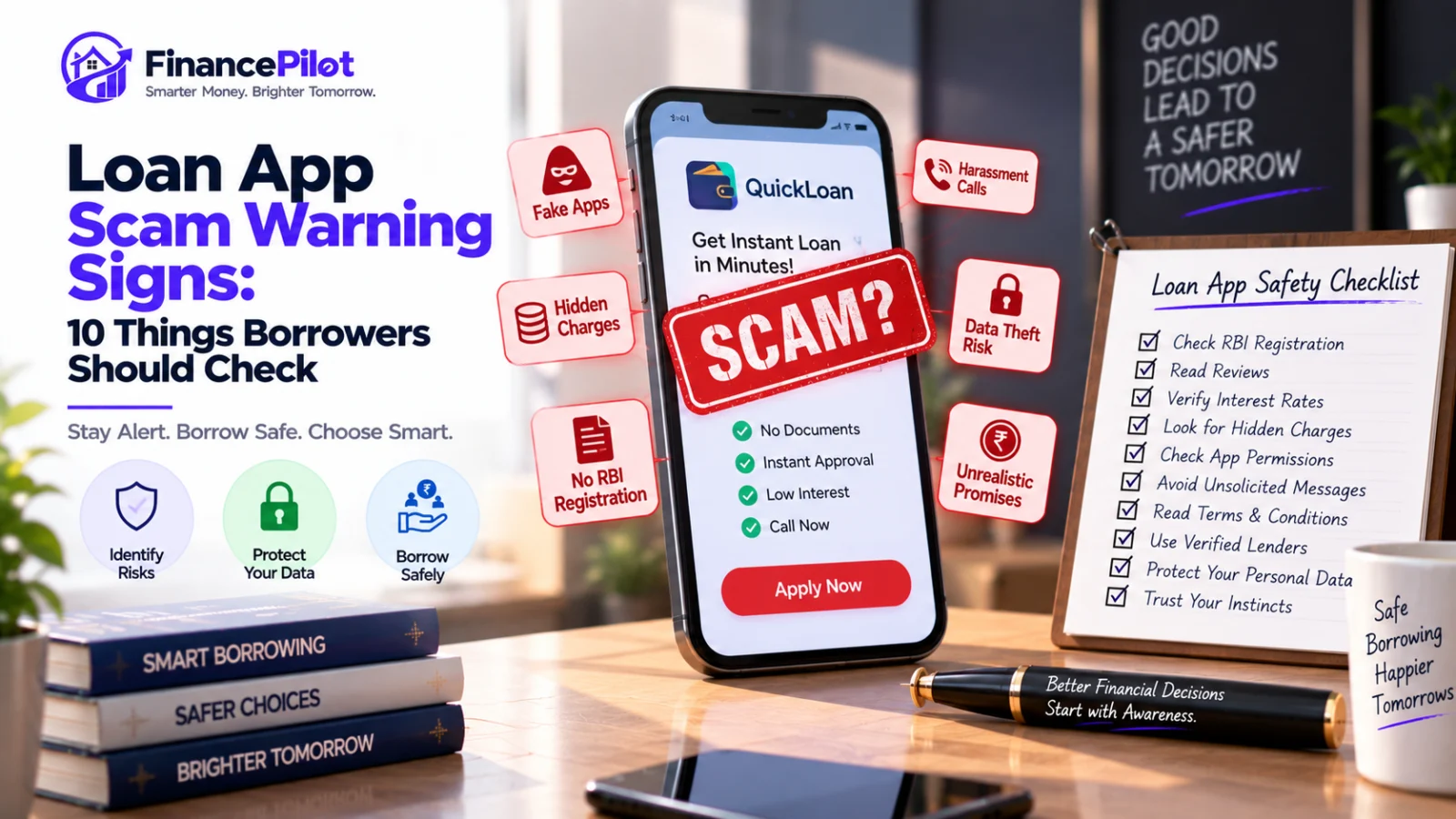
The pitch is always the same, ₹10 lakh instantly, no documents, no credit check, approved in five minutes. It looks professional, has thousands of downloads, and decent-looking reviews. Then the money either never arrives, or it does, followed within days by threatening calls to your family, your colleagues, and your employer, over a debt that was manufactured through inflated fees and manipulated terms from the start. Over 500 fraudulent lending apps are estimated to be operating in India right now, and RBI’s own working group first flagged more than 600 illegal apps charging interest rates of 300 to 400 percent annually back in 2021. The problem has not gone away, it has gotten more sophisticated.
Here are the ten warning signs worth checking before you download or apply to any lending app, plus what to do if you already have.
Why This Keeps Growing Even in 2026
Fraudulent apps have adapted well beyond simple fake websites. Several now use AI-generated voice calls, deepfake videos impersonating police or legal officials, and fabricated court notices to pressure victims into paying more. Another pattern makes enforcement genuinely difficult, when an app gets banned or removed, the exact same fraudulent code frequently reappears within days under a completely new name and developer listing, restarting the same scheme against a fresh set of victims.
1. No Disclosed NBFC or Bank Partner
Every legitimate digital lending app in India is required to clearly name the RBI-registered bank or NBFC that is the actual lender behind the app, something like “Powered by [Company Name], an RBI-registered NBFC.” If an app claims to lend directly without naming this specific, verifiable partner, or only references a vague “fintech partner” with no company details, treat this as a serious red flag.
2. Claims to Be “RBI Approved”
This phrase itself is a warning sign. RBI does not approve, endorse, or certify individual lending apps. It registers NBFCs and banks as licensed financial entities, a completely different thing. The Fintech Association for Consumer Empowerment has specifically flagged apps that misleadingly claim RBI approval when no such endorsement exists for any app, only for the underlying regulated entity.
3. Excessive Permission Requests
Legitimate lending apps require camera access only for a KYC selfie and basic document upload. An app demanding full access to your contacts, call logs, photo gallery, and precise location before you have even completed your application is very likely planning to misuse that data later, commonly for harassment and blackmail if you fall behind on payment or if the “loan” itself turns out to be fraudulent from the start.
4. Any Upfront Fee Before Loan Disbursal
RBI guidelines explicitly prohibit collecting processing fees, insurance charges, or GST payments before a loan is actually disbursed. Legitimate lenders deduct any applicable fees from the loan amount itself after disbursal, never before it. Any app asking you to pay something first to “unlock” or “release” your approved loan amount is running a classic advance-fee scam.
5. No Credit Check, Instant Approval for Everyone
A genuine lender, regardless of how fast its digital process is, still needs to assess your creditworthiness in some form before approving a loan. An app promising guaranteed approval for anyone, with zero credit check and no meaningful underwriting, is either operating illegally or setting up a bait-and-switch where the real terms only surface after you have shared your data and, often, made an upfront payment. Our guide to how much personal loan you can get on your salary explains how legitimate lenders actually calculate eligibility, a process no genuine lender can skip entirely.
6. No Verifiable Physical Office Address
Legitimate NBFCs and their lending apps disclose a real, checkable registered office address, one you can actually search and verify on a map. Fraudulent apps typically provide only a generic email address, frequently a free Gmail or similar account, with no traceable physical location anywhere in India.
7. Missing or Vague Privacy Policy and Terms
A proper lending app publishes a clear, specific privacy policy and terms and conditions covering exactly what data it collects, how interest and fees are calculated, and what happens in case of default. If this information is absent, extremely vague, or written in a way that avoids specifics entirely, that vagueness is itself the point, it protects the operator rather than informing you.
8. Interest Rate and Total Cost Not Clearly Disclosed Upfront
Under RBI’s digital lending framework, every registered lender must provide a Key Fact Statement disclosing the full annual percentage rate and all applicable charges before you commit to the loan. Our comparison of personal loans and credit card loans covers this Key Fact Statement requirement in more detail, and its absence on any lending app is a clear sign the platform is not following RBI’s mandated disclosure rules.
9. Negative Reviews Mentioning Harassment or Blackmail
Before installing any lending app, search the app’s name alongside words like “complaint,” “fraud,” or “harassment.” A pattern of reviews describing aggressive recovery calls, threats to contacts, or unexplained charges is a strong, specific signal to avoid the platform entirely, regardless of how attractive its advertised terms look.
10. The App Reappeared Under a New Name After a Previous Ban
Because there is no single, permanently updated official blacklist that keeps pace with how quickly these operators rebrand, checking a specific app against last year’s banned list is not sufficient protection on its own. If a lending app’s branding, terms, or team closely resembles a previously banned platform, or if a quick search turns up its name alongside a prior enforcement action under a slightly different name, treat this history as disqualifying regardless of what the current version claims.
How to Actually Verify a Lending App Before You Apply
The single most protective step, and it takes only a few minutes, is checking the named NBFC or bank partner directly on the RBI’s official website or the RBI Sachet Portal, which lists registered entities and allows you to report suspected unauthorised lenders. If the app does not name a specific, verifiable partner at all, there is nothing to check, which is itself your answer. Our guide to why personal loan applications get rejected is worth reading separately if you are getting rejected by legitimate lenders and feeling pushed toward a faster, less scrupulous alternative, since that pressure is exactly what fraudulent apps are designed to exploit.
What to Do If You Have Already Been Scammed
If you have already shared personal data, made a payment, or are facing harassment from a fraudulent lending app, file a complaint at your nearest cyber crime police station immediately, bringing screenshots of the app, all communications, and any bank transaction records. Contact your bank right away if you shared account details or net banking credentials, so they can monitor or block unauthorised transactions. It is worth knowing that money extracted by an unregistered, unlicensed operator is not a legally enforceable debt in the way a loan from a genuine, registered NBFC is, and continuing to pay under duress does not resolve anything, it simply rewards the people responsible. Consulting a consumer protection lawyer is strongly advisable if significant amounts are already involved.
Frequently Asked Questions
How can I check if a loan app is registered with RBI?
Search for the specific NBFC or bank name the app claims to partner with directly on the RBI’s official website or the RBI Sachet Portal. If the app does not clearly disclose a named, verifiable lending partner, there is no legitimate registration to check in the first place.
Is it true that RBI approves individual loan apps?
No. RBI registers and regulates NBFCs and banks as licensed financial entities, but it does not approve, certify, or endorse individual lending apps. Any app specifically claiming to be “RBI approved” is misusing that phrase, since no such endorsement exists for apps themselves.
Why do fraudulent loan apps ask for contact list and gallery access?
Legitimate lenders only need camera access for a KYC selfie and document upload. Apps requesting your full contacts, call logs and gallery are typically planning to misuse that data later for harassment or blackmail if you fall behind on payment, or from the very start if the loan itself is fraudulent.
Do I have to repay a loan taken from an unregistered fake loan app?
Money extracted by an unregistered, unlicensed operator generally does not constitute a legally enforceable debt the way a loan from a genuine, RBI-registered NBFC does. If you are facing pressure to repay such an app, consulting a consumer protection lawyer is strongly recommended rather than continuing to pay under duress.
What should I do immediately if a loan app is harassing me or my contacts?
File a complaint at your nearest cyber crime police station with screenshots and transaction records, contact your bank to block any further unauthorised access, and report the app through the RBI Sachet Portal so the platform can be investigated and potentially shut down.